In the fast-changing world of surveying tech, the new Brush Rover Rtk system really stands out as a game-changer when it comes to getting precise measurements. According to research from the National Society of Professional Surveyors, there's been a big uptick in how much folks need super accurate positioning — they're expecting the market for Real-Time Kinematic (RTK) solutions to grow by over 25% each year. It’s no surprise, honestly, since industries like construction and environmental monitoring—where accuracy isn’t just nice to have but absolutely essential—are driving this demand.
One industry expert, Dr. Jonathan Smith, who's pretty well-known in geospatial circles, puts it simply: ‘The Brush Rover RTK system totally changes the game for surveyors, giving them unmatched precision that directly impacts how successful their projects turn out.’ When surveyors can work more accurately, it not only makes their lives easier but also helps avoid costly mistakes along the way.
As tech keeps pushing forward in this field, the Brush Rover RTK is quickly becoming a must-have tool for professionals who want reliable, accurate data. In this article, we’ll take a closer look at how it works and why it’s such a critical upgrade that's helping modern surveyors meet the tough demands of today’s projects.
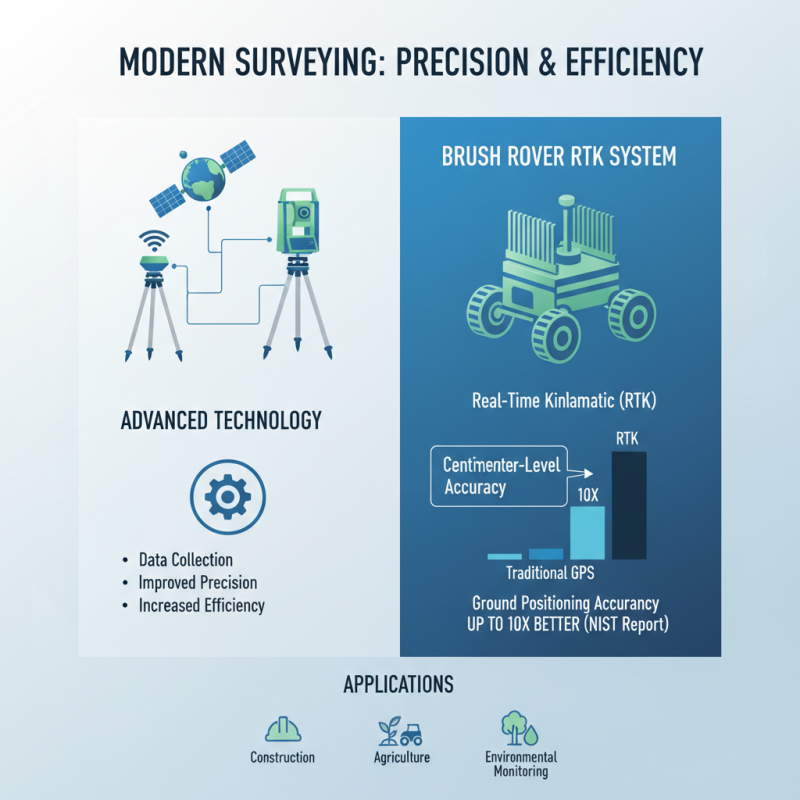
Modern surveying heavily relies on advanced technology to improve precision and efficiency in data collection. One such innovation is the Brush Rover RTK system, which plays a vital role in enhancing surveying accuracy. Real-Time Kinematic (RTK) positioning significantly reduces the margin of error in spatial data collection, achieving centimeter-level accuracy. According to a report by the National Institute of Standards and Technology, RTK can improve accuracy in ground positioning by up to 10 times compared to traditional GPS methods. This advancement is crucial for various applications, including construction, agriculture, and environmental monitoring.
The Brush Rover RTK system utilizes a combination of satellite signals and ground-based reference stations, allowing surveyors to obtain real-time corrections. This integration leads to more reliable data, minimizing the need for post-processing and accelerating project timelines. Moreover, industry analysis indicates that the adoption of RTK technology in surveying has increased by over 30% in recent years, reflecting the growing recognition of its benefits. As the demand for precise geographic information continues to rise, systems like the Brush Rover RTK are becoming indispensable tools for professionals in the field, ensuring that projects are completed with both speed and accuracy.
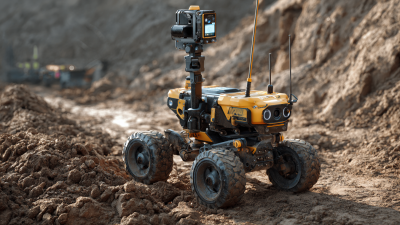
The Brush Rover RTK system is a cutting-edge technology designed to significantly improve the accuracy of surveying tasks. At its core, the system utilizes Real-Time Kinematic (RTK) positioning, which effectively enhances location precision by comparing signals from fixed base stations to the moving rover. This method can provide centimeter-level accuracy, a crucial requirement for modern surveying projects that demand high reliability and precision.
Key technologies behind the Brush Rover RTK include multi-frequency Gnss Receivers, which can capture signals from multiple satellite systems, ensuring robust and accurate positioning data. Additionally, advanced algorithms process this data in real-time, filtering out errors caused by atmospheric conditions and multi-path effects. The integration of communication technologies, such as cellular networks or radio links, allows the rover to receive correction data quickly, making it an effective tool for time-sensitive surveying operations. Together, these technologies streamline workflows and enhance the overall productivity of surveying professionals, allowing them to deliver precise results with greater efficiency.
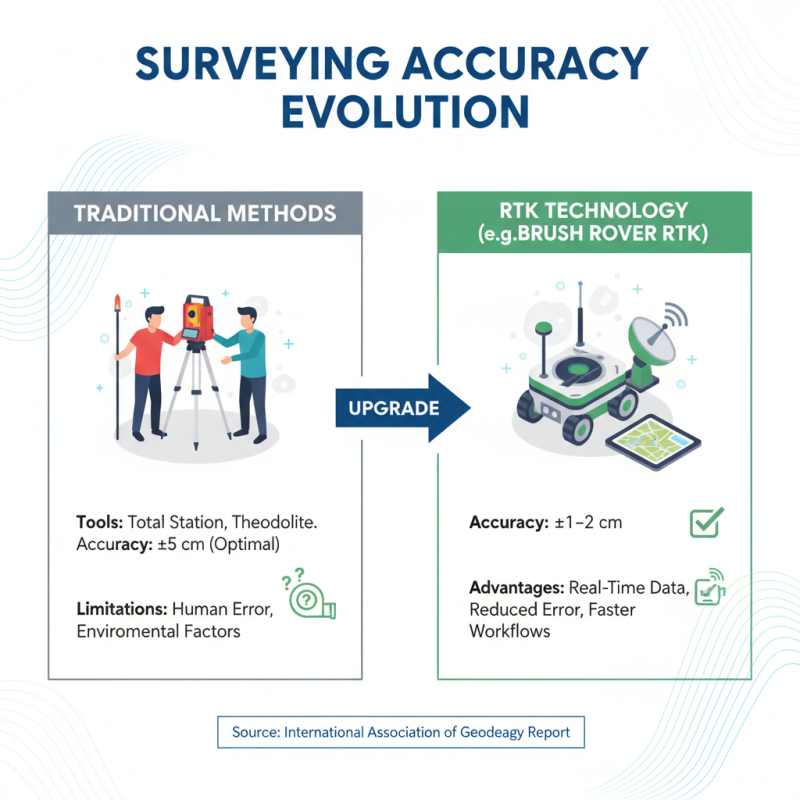
The advent of Real-Time Kinematic (RTK) technology has revolutionized the surveying industry, positioning systems like Brush Rover RTK as a pivotal upgrade over traditional surveying methods. Traditional techniques often rely on tools such as total stations and theodolites, which can lead to inaccuracies due to human error and environmental factors. According to a report by the International Association of Geodesy, traditional surveying methods can achieve accuracies of around ±5 cm in optimal conditions, but this can vary significantly in the field.
In contrast, RTK systems can consistently provide centimeter-level accuracy, with some studies indicating precision levels of ±2 cm or better in real-time applications. A comparative analysis highlighted by the American Society of Civil Engineers showed that crews using RTK technology could complete surveying tasks 30-50% faster than those relying on conventional techniques. This enhancement not only increases productivity but also minimizes project delays caused by re-measurements and corrections, ultimately improving project outcomes in engineering and construction sectors.
Moreover, the integration of GNSS technology with RTK capabilities allows for greater flexibility in challenging conditions, such as dense urban environments or diverse terrains, where line-of-sight can be obstructed. In a detailed industry analysis, it was noted that the use of RTK can significantly reduce surveyor fatigue, as real-time data processing lessens the need for repeated manual readings. As a result, the surveying landscape is shifting towards more advanced technologies that elevate the standards of precision and efficiency.
Brush Rover RTK technology is revolutionizing various industries by significantly enhancing surveying accuracy. Its high-precision positioning capabilities make it a valuable tool in construction, agriculture, and environmental monitoring. In construction, professionals utilize Brush Rover RTK for site layout and alignment, ensuring that structures are built according to precise specifications with minimal error margins. This leads to cost savings and reduces the risk of errors that could result in costly modifications.
In agriculture, Brush Rover RTK facilitates precision farming practices. Farmers benefit from enhanced data collection for crop management, enabling them to optimize planting patterns and improve yield forecasts. By understanding the topography and variations in soil, farmers can make informed decisions about irrigation and fertilization, ultimately maximizing productivity and sustainability.
Tip: When integrating Brush Rover RTK into your workflow, ensure that operators are properly trained to utilize the technology's full potential. Familiarize yourself with data interpretation methods to leverage the insights gained from precise measurements effectively.
Moreover, in environmental monitoring, this technology aids in mapping and evaluating changes in ecosystems. With the ability to capture accurate geospatial data, researchers can analyze habitat changes and track environmental impact more effectively. Implementing Brush Rover RTK in these diverse fields illustrates its adaptability and the critical role it plays in fostering precision and efficiency.
Tip: Regularly update the software used with Brush Rover RTK systems to ensure compatibility with the latest features and improvements, enhancing functionality across various applications.
The Brush Rover RTK system stands out in the field of surveying by delivering sub-centimeter precision, revolutionizing the way professionals approach land measurement and mapping tasks. This cutting-edge technology relies on Real-Time Kinematic (RTK) positioning, which utilizes satellite signals for real-time corrections, allowing surveyors to achieve unparalleled accuracy in their coordinates. By minimizing errors associated with traditional surveying methods, the Brush Rover RTK promotes efficiency and reliability in various applications, from construction to environmental monitoring.
Tips for using RTK systems effectively include ensuring optimal satellite visibility—avoid obstructions like buildings or trees that can interfere with signals. Additionally, familiarizing yourself with the equipment and software can streamline the data collection process, making it more intuitive and less time-consuming. Regularly calibrating your equipment is also essential to maintain accuracy, as small deviations can lead to significant errors in measurements over large distances.
Another critical aspect is understanding the environmental conditions that may affect performance. For instance, factors such as atmospheric interference or multipath signals can lead to inaccuracies. To mitigate these issues, consider monitoring weather conditions and conducting surveys during times when atmospheric stability is higher. By following these best practices, users can fully leverage the capabilities of RTK systems, ensuring high-quality results in their surveying projects.
User experiences with advanced surveying technologies like Brush Rover RTK have shown significant enhancements across various projects. For instance, in urban planning, surveyors reported a marked improvement in the precision of land measurements, which allowed for more accurate mapping of infrastructure and better-informed decision-making in design and construction. Many professionals noted that the system's real-time kinematic capabilities reduced errors typically associated with traditional methods, leading to faster project timelines and reduced costs.
In agricultural surveying, users highlighted how the Brush Rover RTK facilitated precise field mapping, enabling farmers to optimize their land management practices. In one case study, a farming cooperative utilized the technology to develop detailed layouts for crop rotation and irrigation systems, resulting in a substantial increase in yield. The ease of integrating the tool into existing workflows was also praised, as users found that it complemented their current equipment without the need for extensive retraining or additional resources. These experiences underscore the transformative impact of advanced surveying technologies on accuracy and efficiency across diverse sectors.
The evolution of Real-Time Kinematic (RTK) technology in surveying has transformed the industry, particularly in terms of accuracy and efficiency. As a testament to its significance, a report from MarketsandMarkets projects that the global RTK market will reach USD 6.4 billion by 2027, growing at a compound annual growth rate (CAGR) of 16.6%. This surge is attributed to the increasing demand for precise geospatial data across various sectors, including construction, agriculture, and mapping.
One of the notable trends is the integration of advanced GNSS (Global Navigation Satellite System) technologies with RTK systems. This integration allows for enhanced positioning accuracy, often achieving centimeter-level precision. According to a study by Geospatial World, the future of RTK technology will also see the incorporation of artificial intelligence and machine learning to automate data collection and processing, further reducing human error and time spent in the field. Such advancements not only push the boundaries of surveying capabilities but also enable surveyors to tackle complex projects with greater confidence and precision, setting a new standard in the industry.
Moreover, the rise of cloud computing in surveying practices facilitates real-time data sharing and collaboration. By leveraging cloud-based platforms, surveyors can access high-quality datasets, conduct analyses, and implement dynamic adjustments immediately, which enhances workflow efficiency. As the industry continuously evolves, the integration of these innovative technologies into RTK systems is poised to reshape the future of surveying, providing unparalleled accuracy and operational capabilities.
: The Brush Rover RTK system is a technology that utilizes Real-Time Kinematic (RTK) positioning to achieve centimeter-level accuracy in spatial data collection, significantly reducing the margin of error compared to traditional GPS methods.
The adoption of RTK technology has increased due to its ability to provide more reliable data with real-time corrections, minimizing the need for post-processing and accelerating project timelines, leading to greater efficiency in various applications like construction and agriculture.
Future trends indicate that RTK technology will integrate advanced Global Navigation Satellite System (GNSS) technologies, artificial intelligence, and machine learning to automate data collection and processing, enhancing accuracy and reducing human error.
The global RTK market is projected to reach USD 6.4 billion by 2027, growing at a compound annual growth rate (CAGR) of 16.6%, driven by the increasing demand for precise geospatial data.
Cloud computing facilitates real-time data sharing and collaboration among surveyors, allowing them to access high-quality datasets and conduct analyses that enhance workflow efficiency and enable immediate dynamic adjustments.
RTK technology allows surveyors to tackle complex projects with greater confidence and precision by providing advanced positioning accuracy and enabling quick corrections, ultimately pushing the boundaries of surveying capabilities.
The demand for RTK technology is growing across various sectors, including construction, agriculture, and environmental monitoring, as the need for precise geographic information continues to rise.
The Brush Rover RTK system provides real-time corrections via a combination of satellite signals and ground-based reference stations, resulting in more reliable data that can be used immediately without extensive post-processing.
Artificial intelligence is expected to be incorporated into RTK technology to automate data collection and processing, further enhancing accuracy and efficiency in surveying operations.
Accurate surveying is crucial for applications like construction, agriculture, and environmental monitoring, as it enables effective planning, execution, and management of projects, ensuring optimal outcomes.
The article "What is Brush Rover RTK and How Does it Enhance Surveying Accuracy" explores the cutting-edge capabilities of the Brush Rover RTK system in modern surveying. It delves into the key technologies that drive its functionality, highlighting how this system improves precision in comparison to traditional surveying methods. The analysis reveals that Brush Rover RTK excels in various industry applications, achieving sub-centimeter accuracy that significantly enhances data reliability in surveying projects.
Moreover, the article presents user experiences through case studies, illustrating the practical benefits of the Brush Rover RTK in diverse settings. As RTK technology continues to evolve, the insights provided in this piece emphasize its growing importance in the surveying sector, paving the way for future advancements that will further refine accuracy and efficiency.